





Why governance now determines success or risk
Imagine this: A file with salary information is somewhere on SharePoint - not perfectly protected. A colleague uses Microsoft Copilot, to request a project summary and suddenly the salary data of all employees appears. Sounds like a horror scenario?
Such cases make it clear that innovation without the appropriate framework quickly becomes a risk. If technology and compliance do not work hand in hand, blind spots arise in which data gets out of hand.
About the author

Dr Marija Stambolieva
Senior Consultant Compliance Management, Information Security, Data Protection & AI Officer


About the author
Dr Marija Stambolieva
Senior Consultant Compliance Management, Information Security, Data Protection & AI Officer
Why governance now determines success or risk
Imagine this: A file with salary information is somewhere on SharePoint - not perfectly protected. A colleague uses Microsoft Copilot to request a project summary and suddenly the salary data of all employees appears. Sounds like a horror scenario?
Such cases make it clear that innovation without the appropriate framework quickly becomes a risk. If technology and compliance do not work hand in hand, blind spots arise in which data gets out of hand.
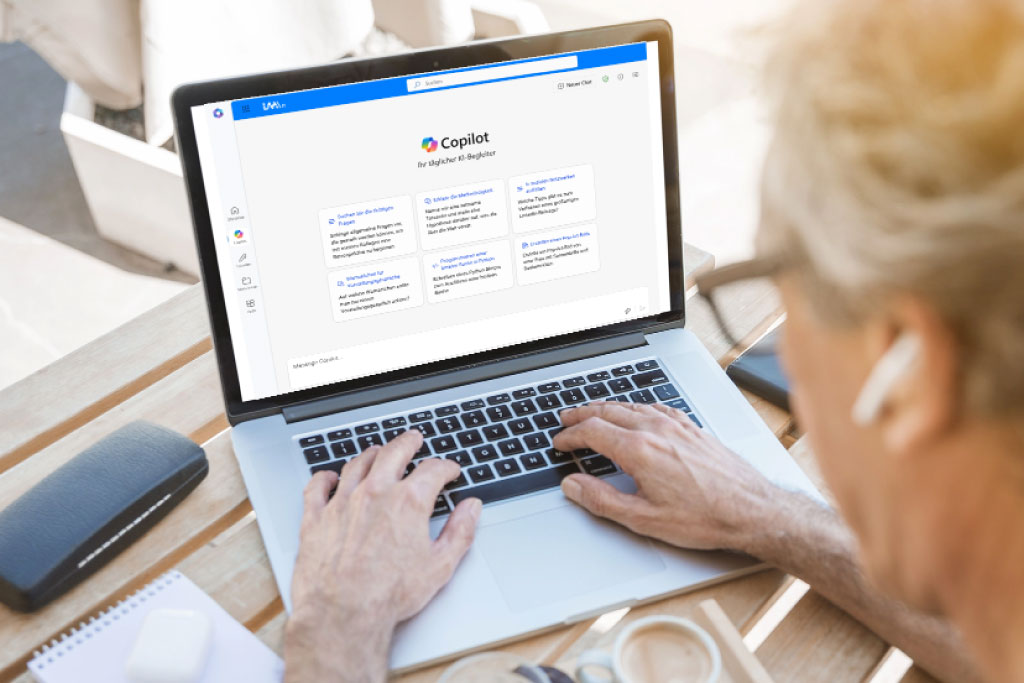
The invisible risk - when we don't know our data
Data is distributed across Teams, SharePoint, OneDrive and local folders. But what is confidential? What can be shared, with whom and for how long? These questions are often not clearly answered. With AI, this lack of clarity becomes problematic: AI models link data sources. What was already confusing before becomes intelligently confusing - a dangerous combination.
Standards and regulations such as ISO 27001, NIS-2, DORA, the GDPR or the EU AI Regulation all emphasise the same principle: Know your data. Because you can't protect what you don't know, let alone use it responsibly for AI.
Microsoft 365 toolbox
The good news: Microsoft 365 offers integrated tools, to create clarity, for example about authorisation and labelling policies.
Authorisations
Copilot only accesses content for which the respective user already has at least read authorisation. Existing role and authorisation concepts in the Microsoft environment remain completely intact, including confidentiality designations, retention policies and administrative guidelines.
When connecting additional data sources, such as local folders, administrators must be configured in the Copilot connectors ensure that the authorisations are configured correctly. If, for example, content is shared there for the entire organisation instead of only for people with actual access in the original data source, this can lead to unwanted data access.
Confidentiality designations (labels)
Microsoft Purview allows you to define labels (e.g. public, internal, confidential) that combine data classification and protection mechanisms. These labels remain persistent - even if documents are moved, shared or exported.
Protection mechanisms such as encryption, content marking (watermarks, header/footer) and access controls remain bound to the document by the configured label.
Governance & compliance - from rules and regulations to practised responsibility
Technology alone is not enough. Providers such as Microsoft offer protection mechanisms, but the responsibility for implementation lies with the company itself. Governance is the framework, that combines technology, compliance and corporate culture. For example, authorisations must be clearly defined and admins must know how to implement settings correctly. Before this happens, however, it must be clarified who develops the authorisation concept, who monitors its implementation and how responsibility is distributed between management, authorised representatives and the IT team.
Guidelines are the organisational backboneAI guidelines regulate the handling of AI within the organisation. Labelling policies define which data classifications and protection mechanisms apply. Of course, this organisational part is time-consuming - classifying data, coordinating rules, carrying out training, checking implementation. But the economic added value is clear: those who take governance seriously protect their values, fulfil regulatory standards and gain the trust of customers and partners.
Conclusion
Secure data is not a nice-to-have, but the Basis for the successful use of AI. Investing in governance and close cooperation between IT and compliance not only protects against risks, but also creates the basis for the secure and responsible use of modern technologies.
If Microsoft Copilot is not only to be activated technically, but also introduced in a structured and sustainable manner, the decisive step begins with a clear strategy: technical preparation, defined governance guidelines, employee training and specific use cases all need to be considered together. We support companies in precisely this initial step: from analysing the initial situation and secure piloting to productive use, including the governance framework and initial measurement of success.
Do you have any questions?
Would you like to know how Copilot can be used securely and compliantly in your organisation? Together, we will analyse your existing Microsoft 365 structure, check authorisations, governance frameworks and compliance requirements and show you specifically where there is a need for action. Let us clarify in a structured way how you can enable innovation without overlooking risks.